 17 Jul 2026
To implement the national plans for scientific and technological innovation and science popularization, and to celebrate the 10th National Science and Technology Workers’ Day, ECUST recently organized a series of themed science and technology events.
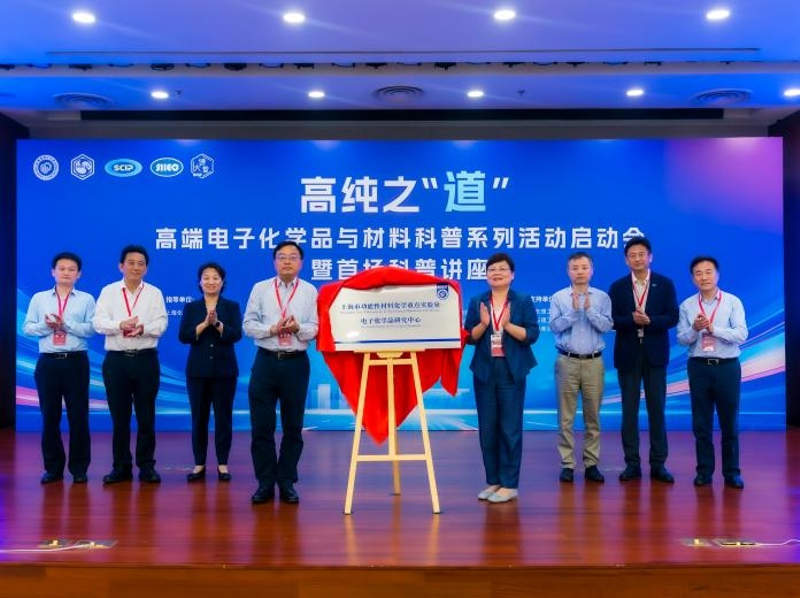
Responding to industrial demands, the university deepened industry-education integration and university-enterprise collaborative innovation. Working with the Shanghai Society of Chemistry and Chemical Engineering and the Shanghai Chemical Industry Park Enterprise Association, ECUST organized a series of science popularization events focusing on high-end electronic chemicals and materials.
The event was chaired by Academician Weihong Zhu and brought together more than 130 industrial specialists, enterprise representatives, faculty and students. Attendees witnessed the unveiling ceremony of the Electronic Chemicals Research Center and held featured discussions on integrated circuit materials, special electronic gases and other key sectors. The activity built links for university-local and university-industry cooperation to promote the high-quality growth of the regional advanced materials industry.
Each school established high-standard platforms for academic exchanges and hosted multiple frontier lectures. The School of Chemistry invited professors from various universities to share research advances in carbene chemistry, AI-assisted material design and other cutting-edge fields, sparking in-depth discussions among faculty and students.
The School of Materials Science and Engineering invited recipients of the National Science Fund for Distinguished Young Scholars to present recent progress in organic materials in biomedicine and boost academic exchanges among universities.
The School of Mechanical and Power Engineering focused on new energy industries and shared research and industrialization experience of intelligent disassembly technology for retired batteries. Balancing science popularization and teaching improvement, the School of Business arranged faculty outreach to middle schools to share social science knowledge and organized interdisciplinary exchanges via featured platforms to integrate teaching and research.
Following emerging technological trends, the university carried out diverse science popularization practices and innovation competitions. The School of Information Science and Engineering organized faculty and student visits to experimental centers to experience humanoid robots, quadruped robots and other intelligent devices, and to stimulate students’ interest in innovation.
Meanwhile, the university held competitions such as the Management Decision Simulation Contest. Competitions supported learning and innovation, helping students develop innovative thinking, teamwork and practical capabilities.
The events covered science communication and the development of research competence. The School of Physics delivered special lectures on artificial intelligence applications and research norms to strengthen academic integrity education. Relying on the Undergraduate Innovation Forum, the school built a platform for student research communication and peer support to help young students establish research aspirations and improve innovation capacity.
The university opened high-quality national research platforms to the public. The State Key Laboratory of Chemical Engineering and Low-Carbon Technology held an online open day with live broadcasts introducing frontier research outcomes. The State Key Laboratory of Bioreactor Engineering hosted a public open day, receiving student visitors from 28 primary and secondary schools in Shanghai. Various science popularization activities enabled young people to experience biomanufacturing technology. The School of Business also organized parent-child science events to expand the reach of science outreach services.
The comprehensive series of activities attracted broad participation and delivered tangible outcomes. It enriched campus innovation culture and strengthened faculty and students’ commitment to contributing to national scientific development. Meanwhile, the events spread scientific knowledge and promoted the spirit of science among the public, especially teenagers, demonstrating ECUST’s responsibility to support national strategies and regional development.
Building on these events, ECUST will continue to organize regular academic exchanges and science outreach programs. The university will further strengthen the cultivation of innovative talents and deepen collaboration among universities, research institutes and industry. By advancing both technological innovation and science communication, ECUST will continue to contribute to China’s pursuit of high-level scientific and technological self-reliance and self-strengthening, and its goal of becoming a leading scientific and technological power.