
New Progress in Single-Molecule Electrocatalytic C–H Activation from ECUST Published in Journal of the American Chemical Society
Recently, the research team led by Academician He Tian from the School of Chemistry and Molecular Engineering, ECUST, has made new progress in single-molecule electrocatalytic C–H activation, constructing high-conductance Au–C covalent molecular junctions at the single-molecule level. The research, titled “Electrocatalytic Benzylic C–H Activation Enables Direct Au–C Single-Molecule Junctions”, was published in Journal of the American Chemical Society.
Traditional C–H bond activation typically relied on directing groups or chemical oxidants, involving cumbersome procedures and harsh conditions. To address this challenge, the research team proposed a novel strategy in which an applied bias is used to drive chemical reactions. By combining this approach with the Scanning Tunneling Microscope Break Junction (STM-BJ) technique, they achieved the in-situ activation of benzylic C–H bonds and the direct construction of Au–C covalent molecular junctions through bias regulation for the first time.
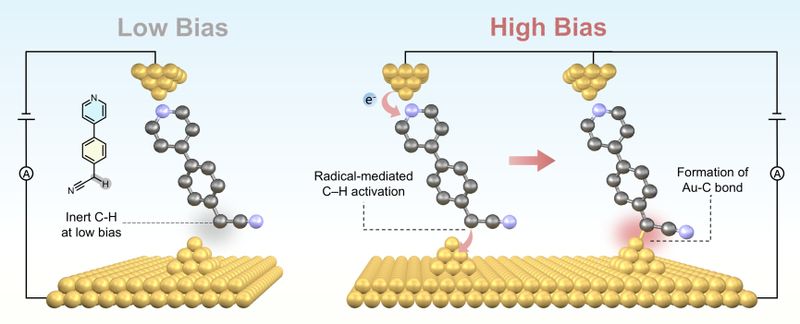
The team systematically investigated the impact of different molecular structures on reaction activity and charge transport properties. Their work revealed the key regulatory roles of molecular length, anchoring sites, and electronic effects on C–H bond activity, while also demonstrating the broad applicability of this method in phenyl acetonitrile derivative systems.
This research not only achieved the direct conversion of C–H bonds to Au–C covalent molecular junctions and provided in situ monitoring of the process, but also offered new mechanistic insights into benzylic C–H bond activation under electrochemical conditions. This breakthrough advanced the construction of covalent connections in single-molecule devices and is of great significance for the precise control of chemical reactions and the devices fabrication at the single-molecule scale.
ECUST is the sole corresponding institution for this research. Academician He Tian, Professor Qi Zou, and Professor Hongxiang Li from the School of Chemistry and Molecular Engineering are the corresponding authors of the paper, while PhD candidate Canqiu Ding is the first author. The research was supported by the National Natural Science Foundation of China, the Science and Technology Commission of Shanghai Municipality, and the Program for Introducing Talents of Discipline to Universities.